Navigating rough-terrain jobsites across Knox County demands verified lifting capacity rather than improvised labor. A compact 5,500-pound telehandler with a 19-foot reach suits historic framing remodels in Fourth and…
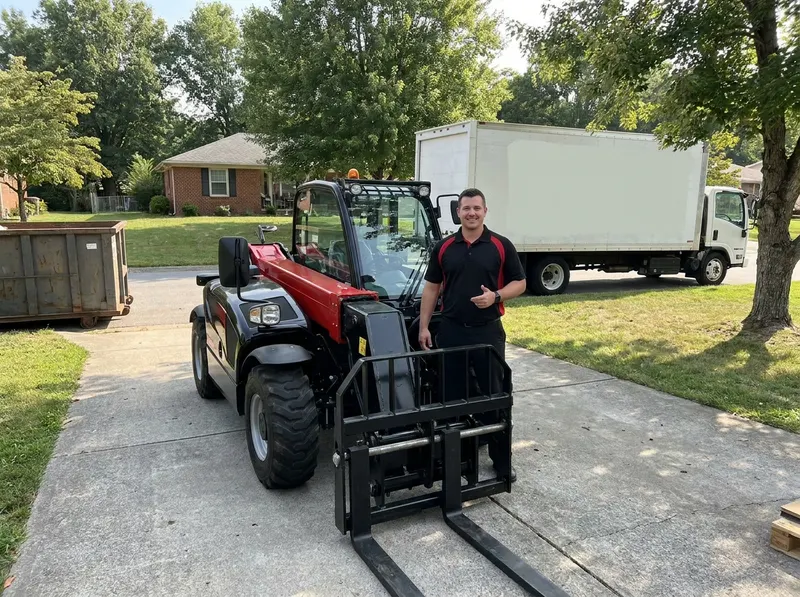
Navigating rough-terrain jobsites across Knox County demands verified lifting capacity rather than improvised labor. A compact 5,500-pound telehandler with a 19-foot reach suits historic framing remodels in Fourth and Gill or tight residential driveways in Sequoyah Hills where overhead tree canopies and narrow lot setbacks limit swing radiuses. For multi-story residential framing or roof replacements along ridge properties in South Knoxville (SoKno) and Fountain City, a 42-foot or 56-foot telescopic boom delivers 8,000 to 10,000 pounds of trusses directly to top plates. The mechanical trade-off rests entirely between footprint and forward reach: ultra-compact telehandlers turn inside a 130-inch radius on slab foundations, whereas 10,000-pound high-reach rigs demand a minimum 14-foot overhead corridor and firm outrigger pads to distribute machine weights exceeding 28,000 pounds.
East Tennessee red clay, steep road banks along Fort Dickerson Park, and grade breaks in Island Home Park require standard four-wheel drive and three distinct steering modes (front, crab, and coordinated round-steer) to spot materials without churning the underlying soil. Equipment delivery utilizes dedicated flatbed haulers traveling major Knox County arteries including Interstate 40, Kingston Pike across Bearden, and Broadway through North Hills. To maintain predictable project progress without labor idling, dispatch provides precise arrival windows instead of broad daylight estimates. Machines arrive fully fueled, pressure-washed, and equipped with proactive tire treads that prevent site gouging when transitioning across finished residential driveways.
Preventing costly operational delays begins with machine site matching. Step 1: calculate the single heaviest pick load plus the required forward horizontal reach, since telehandler lift charts reduce maximum allowable loads as boom extension angles drop toward zero degrees. Step 2: verify local street staging clearances, ensuring no overhead electrical service drops cross the machine travel path between unloading zones and building footprints. Step 3: inspect ground density, deploying laminated hardwood mats beneath outriggers if recent Tennessee Valley rainstorms have saturated the subgrade, keeping loads stable and tires off vulnerable curbs.
Every job gets a firm, written price after a free on-site visit.
Tell us about your material handling and telehandler rental job in Knoxville and we'll send a clear, written quote, usually the same day.
 TossBox Dumpster Rental